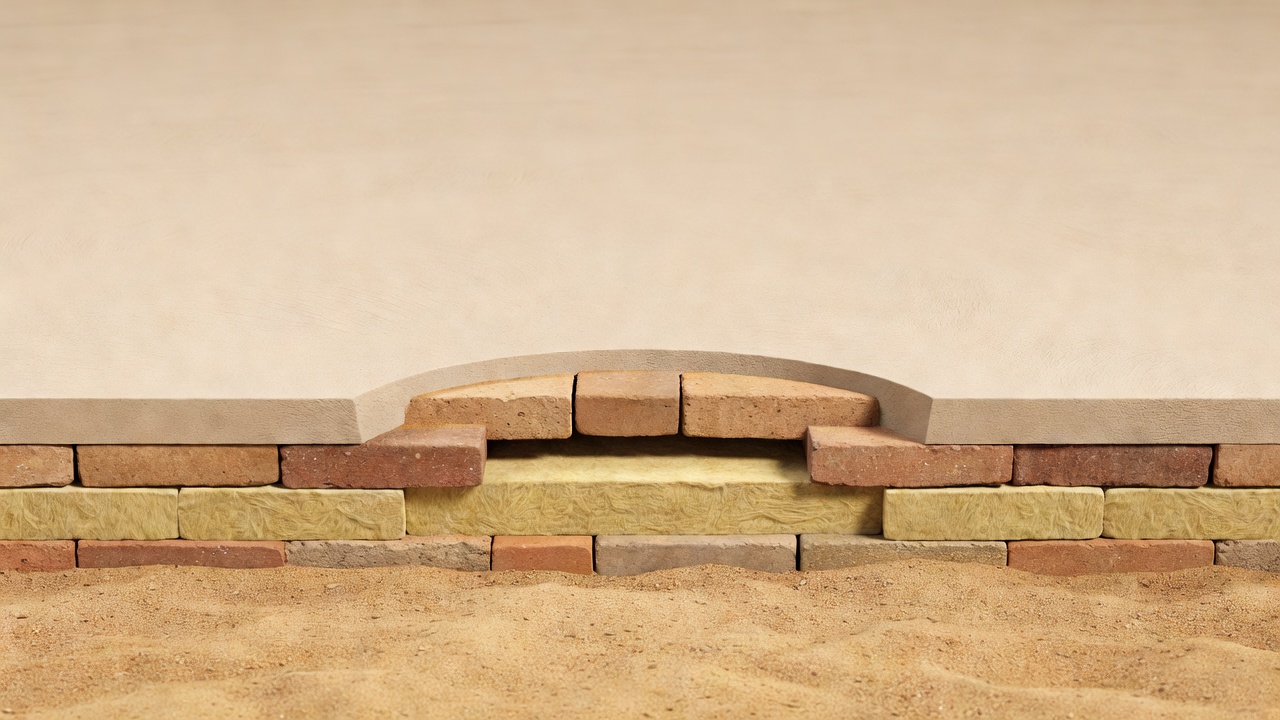
Three things a wall can do
When a radio wave meets a surface, part of it passes through, part reflects and part is absorbed and turned into a tiny amount of heat. Engineers call the overall loss attenuation and measure it in decibels (dB). Every 3 dB of loss roughly halves the signal power; every 10 dB cuts it to a tenth. A few walls in a row add up quickly.
Exact figures depend on thickness, moisture and frequency, so treat any number as a guide. Higher frequencies generally lose more per wall, which is why 6 GHz fades sooner than 2.4 GHz in the same house.
Light materials
Timber stud walls with plasterboard, interior doors, plain single glazing and most furniture are relatively gentle. A single interior partition of this kind is often cited as costing only a few decibels. Open-plan homes built from these materials usually get by with one well-placed access point.
Heavy masonry
Solid brick, stone and concrete are another matter. Thick external walls in older cottages, or concrete floors in apartment blocks, can each remove a large share of the signal, commonly quoted in the range of ten to twenty decibels or more. Reinforced concrete adds a mesh of steel bars, which acts partly as a barrier. Floors are frequently worse than walls, which is why upstairs and downstairs often feel like separate networks.
Metal and coatings
Metal reflects radio waves strongly. The principle is the same one behind the Faraday cage, named after Michael Faraday: a conductive enclosure keeps electromagnetic fields out. Homes contain partial versions of this everywhere:
- Foil-backed insulation and plasterboard, common in loft conversions and modern extensions.
- Metal lath behind old lime plaster in some period houses.
- Low-E glass, whose thin metallic coating keeps heat in and can keep Wi-Fi and mobile signals out.
- Mirrors, backed with a reflective metal layer.
- Appliances such as fridges, washing machines and radiators.
Water and people
Wi-Fi frequencies are absorbed well by water. Fish tanks, full bookcases of damp paper in a basement, houseplants clustered together and, yes, human bodies all soak up signal. A packed room at a party can measurably weaken coverage compared with the same room empty.
Reading your own walls
Walk the house with a phone and note where the connection drops. Drops right behind a single wall usually point to metal or masonry; gradual fading usually points to distance. Knock on walls: a hollow sound suggests stud partitions, a dull solid sound suggests brick or block.
What to do with this map
You cannot easily change your walls, but you can route around them. Put access points on the near side of heavy walls, run cable through difficult floors, and keep the router away from mirrors and metal cabinets. The next zone, Router Placement, turns this into a step-by-step layout.